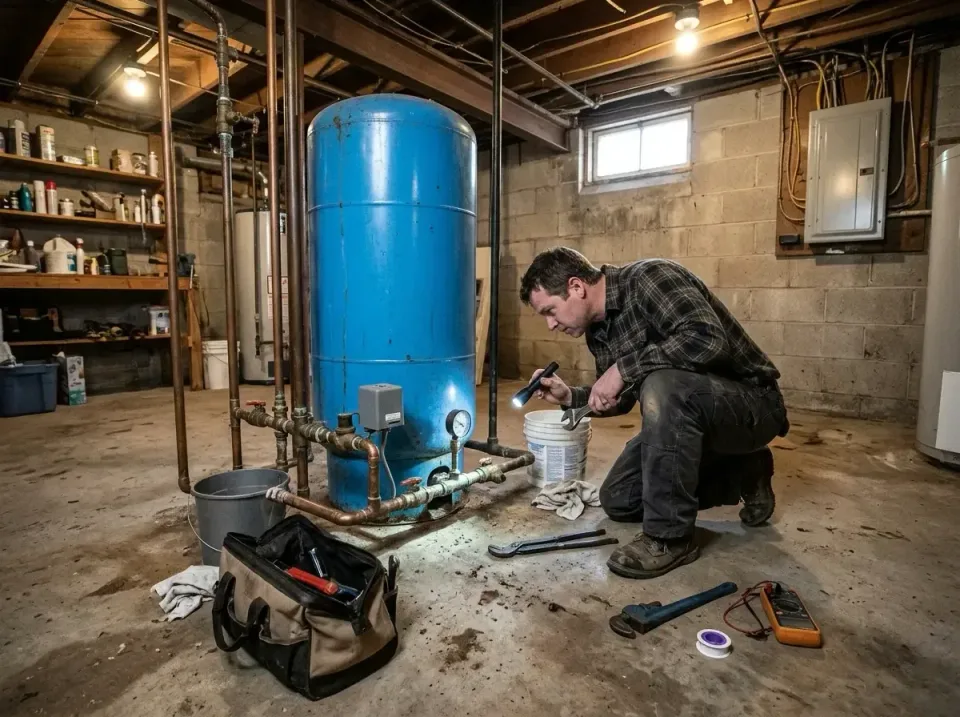
Water Pressure Tank Repair
We repair potable-water pressure tanks for homes, checking tank size and connections; replacement commonly runs $800–$2,500, driven by tank size and installation access.
A shower starts strong, then thins while the kitchen faucet runs. Pressure that surges and fades often points to a well-system or plumbing problem that needs diagnosis, not a quick adjustment.
Start by noticing whether the change affects one fixture or several. That detail narrows the search.
Near the Anchorage Alaska Railroad Depot, a homeowner’s pressure trouble is still a household system issue; note when the flow changes and which taps are running before arranging a check. A visit to the Anchorage Museum might fit into the day, but a pressure reading taken while water is flowing is more useful than a gauge reading with every tap closed.
The Anchorage 5th Avenue Mall is another familiar reference point for local service planning. Ask the plumber to compare those readings and explain the cause before replacing parts.
A brief burst followed by weak flow can mean the system cannot maintain pressure as water is used. On a private well, possible causes include a pressure tank that is not providing its intended reserve, a switch that is not controlling the pump correctly, or a pump struggling to keep up.
The pattern matters: if the pressure drops at several taps together, the cause is more likely upstream than in one faucet. Start by noting when it happens and whether the pump starts repeatedly.
Ted Stevens Anchorage International Airport is a familiar city landmark, but a home’s changing water flow calls for measurements at the pressure system, not guesses based on location. We compare pressure when fixtures are off and running, then explain what the readings suggest.
It can. Spring thaw can expose shifting or damaged water lines, so a pressure change that appears after winter deserves a check for leaks or movement along accessible pipe runs.
A small leak may show up as a pump that runs more often, wet ground, or pressure that fades while water is being used. Do not dig blindly; buried lines can be damaged further by an uninformed excavation.
At homes near the University of Alaska Anchorage, as elsewhere in Anchorage, our crew looks for visible signs first and follows the line’s likely route before recommending repair. High winds can also damage exposed plumbing components, including vulnerable outdoor connections, so inspect what is safely visible after a storm. Leave electrical controls and buried piping to a qualified technician.
A homeowner can safely note which fixtures lose flow, check whether a visible shutoff is fully open, and look for obvious leaks. Stop before opening a pressure switch, changing wiring, or adjusting equipment you do not understand.
The pump circuit can carry hazardous voltage, and an incorrect switch adjustment may make pressure swings worse. If the pump clicks on and off rapidly, stays running, or the pressure falls across multiple fixtures, arrange a professional diagnosis rather than repeatedly resetting equipment.
Our team has served Alaska for more than 11 years; we test the system before recommending a part, and qualifying field staff hold Alaska journeyman plumber certification. For a single upstairs shower symptom, see our guide to weak shower pressure upstairs in Anchorage.
A useful inspection checks the gauge, pump behavior, tank, switch, and visible plumbing for leaks or restrictions. One reading alone can mislead: the technician needs to see how pressure behaves as water flows and how the pump responds afterward.
Ask for the measurements and a plain-language explanation before approving a repair. A pressure regulator problem, failing switch, or damaged line can produce similar symptoms, but each calls for a different fix.
Alaska’s State Capitol is in Juneau, not Anchorage; for an Anchorage home, the practical issue is the condition of the equipment on site. If the faucet drops whenever another fixture runs, our article on pressure changes when another fixture runs covers that pattern. A clear diagnosis prevents replacing parts that are still working.
If water surges at several taps in a private well home, the right repair depends on what testing finds. These options address different failure points; the measurements help distinguish them.
| Option | Best for | Key detail |
|---|---|---|
| Well pump pressure repair | Pressure that fades as demand continues | Pump sizing depends on well yield and vertical lift. |
| Pressure tank bladder replacement | Repeated drops between pump cycles | Residential pressure tanks range from 20–86 gallons; size alone does not establish usable drawdown. |
| Booster pump troubleshooting | A system that needs added pressure | Booster pumps are sized by flow and pressure. |
| Pressure reducing valve repair | Pressure that is too high or uneven downstream | A regulator reduces pressure; it does not supply it. |
| Well pressure switch replacement | Irregular pump start and stop behavior | Common switch settings include 20/40 or 30/50 psi. |
Southcentral winters bring prolonged freezing temperatures, so exposed lines and equipment need protection during service. Summer temperatures vary widely across Alaska; mention seasonal changes if the symptoms come and go.
For homes farther afield, seasonal road access can affect remote service scheduling, so share access details when booking. Valdez Harbor and Worthington Glacier are distinct regional landmarks, not indicators of an Anchorage home’s water system; diagnosis depends on the equipment and site.
A few practical steps help the plumber reach the equipment and understand when the pressure changes. Heavy snowfall can obstruct outdoor equipment access, so clear a safe route to the wellhead without striking buried or exposed lines. Alaska Native Heritage Center is a local landmark; if your home is outside central Anchorage, describe your location and access conditions when arranging the visit.
Record the symptoms: Note which fixtures lose flow, when it happens, and whether the pump starts or stops at the same time.
Clear the equipment area: Move stored items away from the pressure tank, pump controls, and shutoff so the system can be inspected.
Prepare safe access: Provide crawlspace entry and lighting if equipment or water lines are located below the home.
Keep controls untouched: Do not open pump circuits or adjust switch settings before the inspection.
Plan for seasonal conditions: Interior summers can bring warm days and cool nights, so tell the crew about changing access or exposed piping conditions.
Keep the route to the equipment clear and ask what readings the inspection will include.
Yes, snowmelt can raise groundwater around basements, so check for damp areas or water near accessible service piping when pressure changes. Keep clear of wet electrical equipment and have a plumber inspect suspected leaks before opening walls or digging.
Pressure diagnosis is typically $100–$300, including testing and travel; a pressure switch replacement is $200–$600, depending on switch and wiring access. Alaska Plumbing Pros can test the system and explain the likely repair before you decide.
No, avoid opening or adjusting a pressure switch unless you are qualified to work safely around pump wiring; incorrect settings can worsen cycling. If you are near Hatcher Pass or elsewhere outside central Anchorage, describe site access when arranging a visit.
Anchorage plumbing permits should be verified before alterations, and Anchorage electrical permits may be required for pump wiring work. The Alaska Plumbing Code covers applicable plumbing installation requirements, so confirm the scope with the Municipality of Anchorage Development Services Department.
Pressure Tank Repair if several taps surge and fade?
Ask for a system diagnosis first; several affected fixtures can point to a shared pressure-system issue, but the tank is not automatically the cause. Snowmelt can raise groundwater around basements, so mention dampness or water near the tank area when describing symptoms.
A surge that fades is a symptom, not a diagnosis. Pressure readings can change between a fixture-off test and a flowing test, so ask for both before agreeing to replace equipment.
Freeze-thaw cycles stress buried pipes and foundations; visible movement, damp areas, or a new pressure change deserve attention before the issue worsens. Interior Alaska experiences extreme winter cold, making exposed plumbing especially important to check for damage.
Around Eagle River Nature Center, conditions differ from an Anchorage home, but the same careful, site-specific assessment matters. If pressure is changing throughout the house or the pump cycles repeatedly, contact Alaska Plumbing Pros to arrange an inspection.
Our crew will explain the findings and discuss a repair suited to the system. See our Water Pressure Tank Repair service for the next step.
Yes, snowmelt can raise groundwater around basements, so check for damp areas or water near accessible service piping when pressure changes. Keep clear of wet electrical equipment and have a plumber inspect suspected leaks before opening walls or digging.
Pressure diagnosis is typically $100–$300, including testing and travel; a pressure switch replacement is $200–$600, depending on switch and wiring access. Alaska Plumbing Pros can test the system and explain the likely repair before you decide.
No, avoid opening or adjusting a pressure switch unless you are qualified to work safely around pump wiring; incorrect settings can worsen cycling. If you are near Hatcher Pass or elsewhere outside central Anchorage, describe site access when arranging a visit.
Anchorage plumbing permits should be verified before alterations, and Anchorage electrical permits may be required for pump wiring work. The Alaska Plumbing Code covers applicable plumbing installation requirements, so confirm the scope with the Municipality of Anchorage Development Services Department.
Ask for a system diagnosis first; several affected fixtures can point to a shared pressure-system issue, but the tank is not automatically the cause. Snowmelt can raise groundwater around basements, so mention dampness or water near the tank area when describing symptoms.
Browse all nationwide service options and choose the right fit for your project.
We repair potable-water pressure tanks for homes, checking tank size and connections; replacement commonly runs $800–$2,500, driven by tank size and installation access.
Booster Pump Repair covers pump diagnostics and component fixes for homes with inconsistent supply; typical repairs run $300–$1,200, depending on parts and diagnostics.
Well Pump Repair covers pump testing and repairs for homes, with replacement costs of $1,200–$4,500 depending on pump depth and type.
We repair leaking water lines for homeowners and contractors, including accessible pipe sections and excavation; repairs commonly run $400–$3,000 depending on pipe access.
Frozen Pipe Repair for Alaska homes includes locating and safely thawing frozen pipe sections; access, pipe material, and any split line affect the job scope.
We repair residential pressure regulators, checking valve condition and system readings; access and regulator size shape the job, typically $150–$400.
We diagnose sudden household pressure drops, testing flowing and static readings and system controls. Typical diagnostic visits run $100–$300, depending on testing and travel.
We repair or replace household shutoff valves, including accessible copper and PEX connections; typical jobs run $150–$500 depending on access and valve condition.
Clear clogged residential water lines and inspect accessible pipe sections; typical jobs run $250–$1,500, with price driven by blockage and access.
We repair well pressure switches for homeowners, including switch and wiring access; typical replacement runs $200–$600, depending on access.
Goulds Well Pump Repair covers residential pump diagnosis and component repairs; access, pump depth, and parts availability shape the job cost.
We repair residential water softeners, including control and resin-bed issues; diagnostic work is $100–$300, depending on testing and travel.
Shallow Well Pump Repair covers pump, foot-valve, and check-valve faults for private-well homes; access, pump type, and well depth shape the job cost.
Sediment Filter Replacement clears packed grit from residential filter housings; typical cartridge jobs run $150–$450, depending on filter size and access.
Air-in-line diagnosis and repair for Alaska homes, including accessible water-line checks; typical service runs $150–$500, depending on access and repair scope.
Submersible pump repair for Alaska homes includes well-depth and pump checks; replacement work typically runs $1,200–$4,500, depending on depth and pump type.
Grundfos Booster Pump Repair in Alaska: diagnose pump faults, inspect controls, and repair components. Call (877) 773-0781 for a scope review.
Select a city to find local low water pressure repair providers we cover in Alaska.
Share your job scope for low water pressure repair in Alaska — we will review fit and pricing before scheduling.