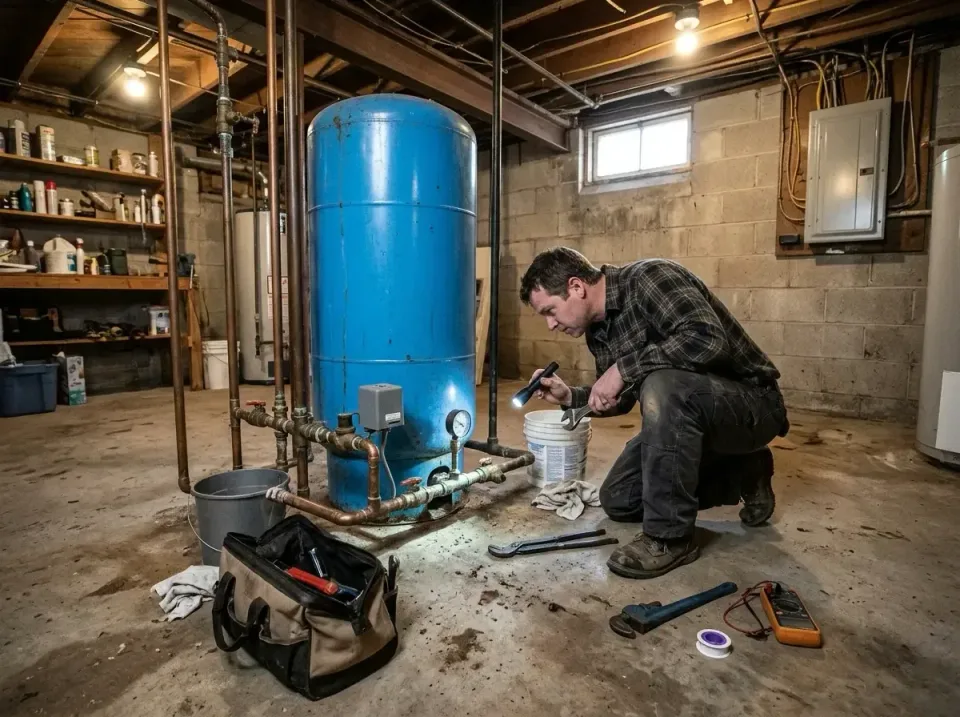
Water Pressure Tank Repair
We repair potable-water pressure tanks for homes, checking tank size and connections; replacement commonly runs $800–$2,500, driven by tank size and installation access.
When the pump starts every few seconds, the pressure tank may be the cause but a switch, leak, or pump problem can produce a similar pattern. In the Alaska well pump and pressure tank system, the tank holds pressurized water so the pump does not need to start for every small draw.
A tank’s size guide matters because its usable drawdown is not the same as its total capacity; choosing too small a unit can mean more starts and wear. Here are useful reference points before diagnosis.
| Check | Practical reference |
|---|---|
| Residential tank sizes | 20–86 gallons |
| Common household pipe | 1/2–1 inch |
| Typical switch settings | 20/40 or 30/50 psi |
| Typical household pressure | 40–60 psi |
We inspect before recommending replacement. At the Alaska Native Heritage Center, as in homes across the state, long winters increase frozen-pipe and well-system risks; a cycling pump should not be left running unchecked.
A pump that starts and stops repeatedly can point to a pressure tank that is not cushioning demand, but cycling alone does not prove the tank has failed. A weak upstairs shower or faucet pressure that drops during use may appear at the same time, especially when the system cannot maintain steady delivery. Note how often the pump starts, whether pressure falls before it turns on, and whether several fixtures are affected.
Common well pump pressure switch settings are 30/50 or 40/60 psi, depending on the system. Those cut-in and cut-out points describe when the pump starts and stops; the wrong switch setting for a system can contribute to poor operation.
We record the gauge behavior before changing anything. Interior Alaska experiences extreme winter cold, so mention any recent freeze exposure or interrupted water service during the inspection.
A pressure switch senses system pressure and signals the pump to start or stop. Contacts that fail, a blocked pressure-sensing passage, or a poor electrical connection can make the pump cycle irregularly even when the tank itself is serviceable. Our field troubleshooting starts by comparing gauge movement with pump operation, then checking the switch and its connections rather than replacing parts by guesswork.
A well pump troubleshooting guide is useful only when it separates symptoms from causes. A short run followed by an immediate restart may fit a tank issue; a pump that runs without reaching its stopping point calls for a broader check. Read about well pressure switch repair signs for more on the switch-versus-replacement decision. (Remove the space before the URL when publishing.)
A damaged bladder can allow the tank’s air and water sides to mix, leaving little usable drawdown and causing frequent starts. A bladder replacement may be possible for some tank designs, while other units require replacement; the tank’s construction and condition decide which route makes sense. We check the tank and system behavior before recommending either option.
Alaska’s long winters increase frozen-pipe and well-system risks, and exposed piping can complicate a tank repair if it has also been damaged. If water flow changes after a cold spell, do not assume the tank is the only fault. A water pressure tank repair assessment can help identify whether the tank, connected piping, or controls need attention.
You can safely note pump start frequency, listen for unusual cycling, and check whether the symptom occurs at one fixture or throughout the home. Stop there if diagnosis requires opening electrical controls, changing switch settings, or depressurizing the system. A well pump puller is specialized equipment used to lift certain well pumps; it is not a homeowner troubleshooting tool, and pulling a pump without the right setup can damage equipment or create a safety risk.
When we coordinate tank work with pump access, we plan the order so the system is not left without water longer than necessary. Alaska Plumbing Pros checks the pressure readings and controls before recommending a repair. For symptoms limited to one fixture, compare them with why faucet pressure drops when another fixture runs in Alaska.
If your washer fills slowly while the pump starts repeatedly, first determine whether the fault is in the tank, switch, pump, or supply line. The symptom alone is not enough. These options address different causes.
| Option | Best for | Key detail |
|---|---|---|
| Tank bladder assessment | Repeated starts with little usable tank drawdown | Bladder tanks separate water and air; older tanks may not |
| Switch diagnosis | Pump starts or stops at inconsistent points | Switch controls cycling; gauge displays pressure |
| Submersible pump inspection | Suspected well pump or retrieval issue | Submersible pumps sit in wells; jet pumps remain aboveground |
| Booster pump troubleshooting | Pressure remains inadequate after supply checks | Booster pumps raise pressure; sizing depends on flow and pressure |
Static pressure is measured without water flowing; flowing readings show how the system behaves under demand. Ask the technician to compare both readings and explain which finding supports the proposed repair. Near Denali National Park and Preserve, long winters increase frozen-pipe and well-system risks, so mention exposed lines when arranging a visit.
A little access preparation helps the technician trace cycling from the tank to the pump controls. Do not adjust electrical settings yourself. Heavy snowfall can obstruct outdoor equipment access, so plan a clear path to the wellhead.
Confirm access: Make sure the wellhead, tank, shutoff, and utility room or crawlspace are reachable.
Clear controls: Remove stored items around pump controls so the technician can inspect them without shifting heavy belongings.
Share symptoms: Record when cycling occurs and whether a shower, faucet, or washer triggers it.
Plan winter access: Clear a safe route to a snow-covered wellhead, especially during Interior Alaska’s extreme winter cold.
Protect the work route: Move fragile items and keep floors clear between the entry and equipment.
Expect an interruption: Set aside water before service in case testing or repair requires a temporary shutdown.
If the home uses a shallow well, ask whether shallow well pump repair is part of the assessment; pump type affects the checks. Booster pump sizing also needs actual flow and pressure needs, not guesswork. University of Alaska Fairbanks is a useful local reference point for Interior communities; confirm access arrangements when booking.
Yes, a pressure tank can contribute to repeated cycling after power returns, but the outage does not prove the tank failed. Note whether the pump reaches its stopping point and whether pressure falls again quickly; Alaska’s long winters also make it sensible to check exposed piping for freeze damage.
Pressure diagnosis is commonly $100–$300, including testing and travel, while pressure tank replacement is $800–$2,500 depending on tank size and installation. Alaska Plumbing Pros can inspect the system and explain which findings support repair or replacement before you decide.
No, do not adjust the pressure switch unless you know the system’s settings and can work safely around pump controls. Record the cycling pattern instead, then have a professional compare the pressure readings and inspect the switch; changing settings blindly can conceal the underlying fault.
Anchorage plumbing permits should be checked before alterations, and the Alaska Plumbing Code sets applicable installation requirements. Pump wiring work may require Anchorage electrical permit approval, so confirm requirements with the Municipality of Anchorage Development Services Department before work begins.
Alaska Native Heritage Center visitors and nearby homeowners alike should also consider how long winters increase frozen-pipe and well-system risks.
If your pump keeps restarting, do not assume a new tank is the answer. A pressure tank can cause short cycling, but the switch, pump, or another system fault may produce similar symptoms.
Keep the wellhead and pump controls accessible so diagnosis does not start with a blocked work area. A pressure-reducing valve adjustment is relevant only if the regulator is actually affecting delivery; changing it without checking the system can mask the real problem.
Armais Arutunoff’s electric submersible pump work helped shape equipment still used in wells, but modern diagnosis still begins with what your gauge and pump are doing. Alaska’s winter conditions make early checks worthwhile. Contact Alaska Plumbing Pros at (877) 773-0781 or arrange a water pressure tank repair assessment; we’ll inspect the system and explain the findings.
Yes, a pressure tank can contribute to repeated cycling after power returns, but the outage does not prove the tank failed. Note whether the pump reaches its stopping point and whether pressure falls again quickly; Alaska’s long winters also make it sensible to check exposed piping for freeze damage.
Pressure diagnosis is commonly $100–$300, including testing and travel, while pressure tank replacement is $800–$2,500 depending on tank size and installation. Alaska Plumbing Pros can inspect the system and explain which findings support repair or replacement before you decide.
No, do not adjust the pressure switch unless you know the system’s settings and can work safely around pump controls. Record the cycling pattern instead, then have a professional compare the pressure readings and inspect the switch; changing settings blindly can conceal the underlying fault.
Anchorage plumbing permits should be checked before alterations, and the Alaska Plumbing Code sets applicable installation requirements. Pump wiring work may require Anchorage electrical permit approval, so confirm requirements with the Municipality of Anchorage Development Services Department before work begins.
Alaska Native Heritage Center visitors and nearby homeowners alike should also consider how long winters increase frozen-pipe and well-system risks.
Browse all nationwide service options and choose the right fit for your project.
We repair potable-water pressure tanks for homes, checking tank size and connections; replacement commonly runs $800–$2,500, driven by tank size and installation access.
Booster Pump Repair covers pump diagnostics and component fixes for homes with inconsistent supply; typical repairs run $300–$1,200, depending on parts and diagnostics.
Well Pump Repair covers pump testing and repairs for homes, with replacement costs of $1,200–$4,500 depending on pump depth and type.
We repair leaking water lines for homeowners and contractors, including accessible pipe sections and excavation; repairs commonly run $400–$3,000 depending on pipe access.
Frozen Pipe Repair for Alaska homes includes locating and safely thawing frozen pipe sections; access, pipe material, and any split line affect the job scope.
We repair residential pressure regulators, checking valve condition and system readings; access and regulator size shape the job, typically $150–$400.
We diagnose sudden household pressure drops, testing flowing and static readings and system controls. Typical diagnostic visits run $100–$300, depending on testing and travel.
We repair or replace household shutoff valves, including accessible copper and PEX connections; typical jobs run $150–$500 depending on access and valve condition.
Clear clogged residential water lines and inspect accessible pipe sections; typical jobs run $250–$1,500, with price driven by blockage and access.
We repair well pressure switches for homeowners, including switch and wiring access; typical replacement runs $200–$600, depending on access.
Goulds Well Pump Repair covers residential pump diagnosis and component repairs; access, pump depth, and parts availability shape the job cost.
We repair residential water softeners, including control and resin-bed issues; diagnostic work is $100–$300, depending on testing and travel.
Shallow Well Pump Repair covers pump, foot-valve, and check-valve faults for private-well homes; access, pump type, and well depth shape the job cost.
Sediment Filter Replacement clears packed grit from residential filter housings; typical cartridge jobs run $150–$450, depending on filter size and access.
Air-in-line diagnosis and repair for Alaska homes, including accessible water-line checks; typical service runs $150–$500, depending on access and repair scope.
Submersible pump repair for Alaska homes includes well-depth and pump checks; replacement work typically runs $1,200–$4,500, depending on depth and pump type.
Grundfos Booster Pump Repair in Alaska: diagnose pump faults, inspect controls, and repair components. Call (877) 773-0781 for a scope review.
Select a city to find local low water pressure repair providers we cover in Alaska.
Share your job scope for low water pressure repair in Alaska — we will review fit and pricing before scheduling.